You booked the venue. The dress is on its way. And then, somewhere between the seating chart and the second tasting, the question lands: what paper do I actually need?
Save-the-dates. Invitations. RSVPs. Details cards. Welcome signs. Programs. Menus. Place cards. Table numbers. Thank-you cards. The list keeps unfurling, and every Pinterest tab you open adds three more pieces you’d never heard of.
This is the wedding stationery guide we wish someone had handed us: one bookmarkable map of the entire paper journey, from the first save-the-date to the last thank-you note. You’ll get a complete checklist, a month-by-month timeline, honest cost ranges, and the difference between digital and printed stationery (and when each one wins). If you’re after a quicker primer first, our shorter wedding stationery 101 overview covers the basics in five minutes.
We make done-for-you digital invitation suites for couples drawn to moodier, more cinematic weddings. That’s why this guide leans editorial. But the framework works whether your aesthetic is candlelit forest or sunlit garden.
Let’s start at the beginning.
In This Article
What Is Wedding Stationery?
Wedding stationery is the full collection of printed and digital paper goods used to communicate, decorate, and document a wedding: from the first save-the-date sent a year out to the thank-you cards mailed after the honeymoon. It includes pre-wedding correspondence, day-of signage, and post-wedding follow-ups, and it’s the single most underestimated category in wedding planning.
Most couples think “stationery” means the invitation. In practice, a fully outfitted wedding has 15 to 25 distinct paper pieces, organized into three clear categories:
- Pre-wedding paper: anything that travels through the mail or arrives in an inbox before the wedding day. Save-the-dates, invitations, RSVP cards, details cards, envelope addressing.
- Day-of paper: anything that lives at the venue. Welcome signs, programs, menus, bar menus, place cards, table numbers, seating charts, thank-you cards left at place settings.
- Post-wedding paper: anything sent after the celebration. Thank-you cards, photo announcements, change-of-address notes.
Every piece has a job. Some manage logistics (RSVPs, accommodations cards). Some set the mood (welcome signs, programs). Some thank the people who showed up. Treat the suite as a single design system rather than a string of one-off purchases, and the whole celebration starts to feel intentional.
The Complete Wedding Stationery Checklist
Use this as your master list. Not every wedding needs every piece. Having the full menu in front of you makes it easier to choose with confidence instead of by panic at week eight.
Pre-Wedding
- Save-the-dates: early notice, sent 8 to 10 months out
- Invitation: the main card, sent 6 to 8 weeks out
- RSVP card: printed reply card or digital RSVP link
- Details / accommodations card: hotel blocks, venue address, dress code
- Weekend itinerary card: for destination or multi-day weddings
- Reception or rehearsal-dinner cards: when these events have separate guest lists
- Envelope addressing: outer and inner envelopes, return-address printing
- Wedding website card: small insert pointing guests online
Day-Of
- Welcome sign: entrance to the ceremony or cocktail hour
- Ceremony program: order of service, wedding party, readings
- Seating chart: alphabetical or by table
- Escort cards or place cards: guest names + table assignments
- Table numbers: one per table, often paired with a small floral arrangement
- Menu cards: at place settings or one per table
- Bar menu / signature cocktail sign: drinks list, often 8×10
- Cards & gifts sign: directs guests to the gift table
- Guest book sign: explains how to sign in
- Favor sign: explains the favor and invites guests to take one
- Photo booth sign or hashtag sign: optional, sets the playful tone
- Thank-you place cards: printed thank-you notes left at each setting
Post-Wedding
- Thank-you cards: sent within three months of the wedding
- Photo announcements: formal portraits sent to immediate family
- Change-of-address cards: for couples moving after the wedding
If this list feels long, that’s because it is. The next section will tell you when each piece actually needs to exist.
Wedding Stationery Timeline: When to Send What
A wedding stationery timeline is less about printing speed and more about giving guests enough lead time to RSVP, book travel, and reserve the date. Here’s the rhythm most planners use, mapped against the broader wedding planning roadmap.
| When | Stationery action |
|---|---|
| 12 months out | Lock the visual identity: colors, fonts, mood. Choose your invitation suite so every paper piece can echo it. |
| 8 to 10 months out | Send save-the-dates. Earlier for destination weddings or holiday-weekend dates. |
| 6 to 8 months out | Order your invitation suite and send us your details. Add envelope addressing if you want it. |
| 2 to 3 months out | Mail invitations. Domestic invitations go 6 to 8 weeks before the wedding; destination weddings need 10 to 12 weeks. |
| 4 to 6 weeks before | RSVP deadline lands. Begin tracking responses, follow up on stragglers. |
| 2 to 3 weeks before | Finalize day-of signage: seating chart, place cards, menus. Send the final headcount to your caterer. |
| Week of | Print or download all day-of paper. Confirm welcome bags, programs, table numbers. |
| Day of | Day-of paper delivered to venue with the rest of decor. |
| Within 3 months after | Thank-you cards mailed. |
The single biggest mistake we see: couples leaving day-of signage until the week of. However fast a seating chart can be set, you want it locked at least two weeks out so a last-minute guest swap doesn’t trigger a 3 a.m. reprint.
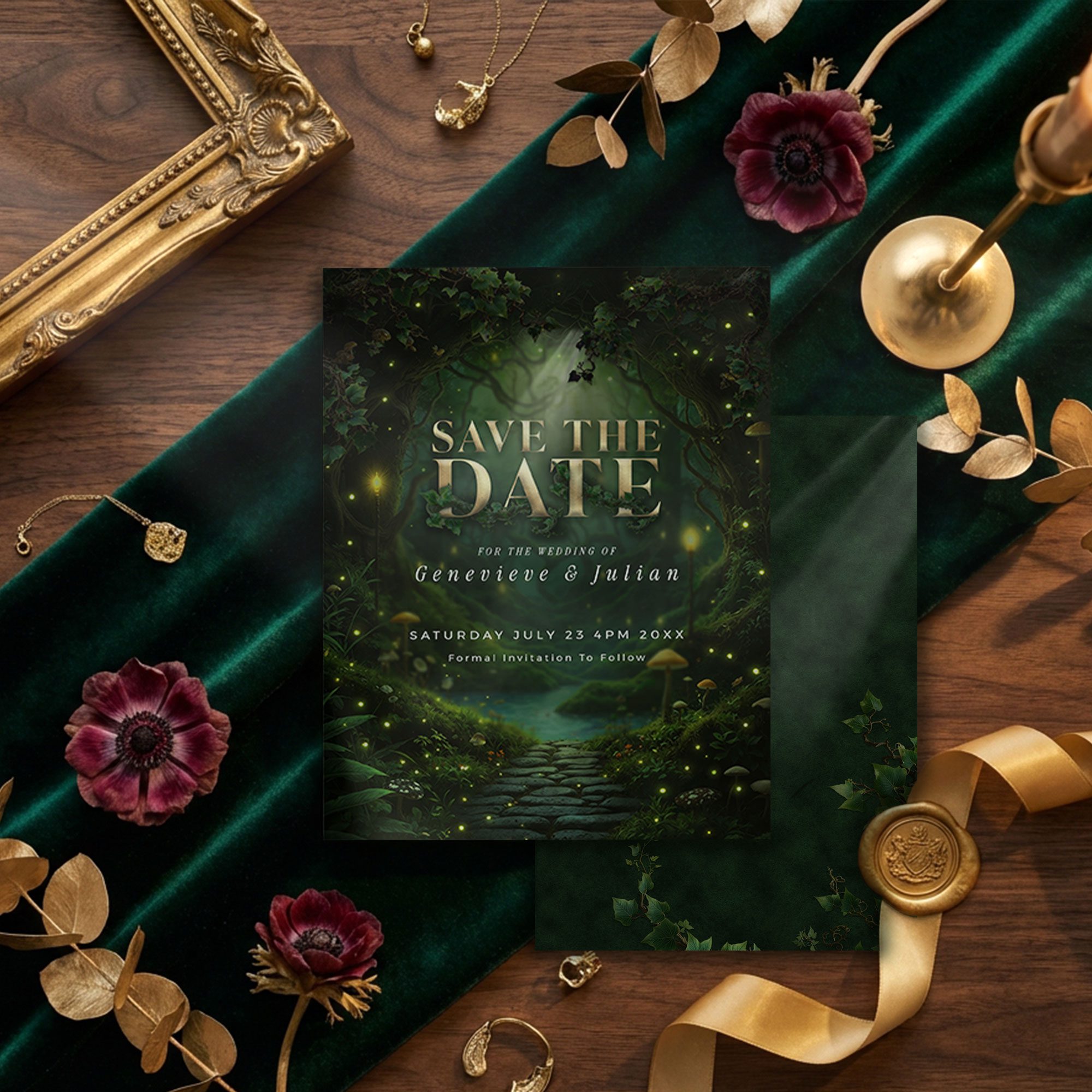
Save-the-Dates: First Impression Paper
Save-the-dates do exactly one job: claim the date on your guests’ calendars before they book a beach trip or a cousin’s birthday. They don’t need to carry every detail. That’s what the invitation is for.
Send them 8 to 10 months before the wedding (12 months for destinations, holiday weekends, or weddings that fall on long-weekend dates). Include only:
- Both partners’ names
- The wedding date (or just the month, if you’re still finalizing)
- The city and state (full venue address waits for the invitation)
- A note that a formal invitation will follow
- Optional: your wedding website URL
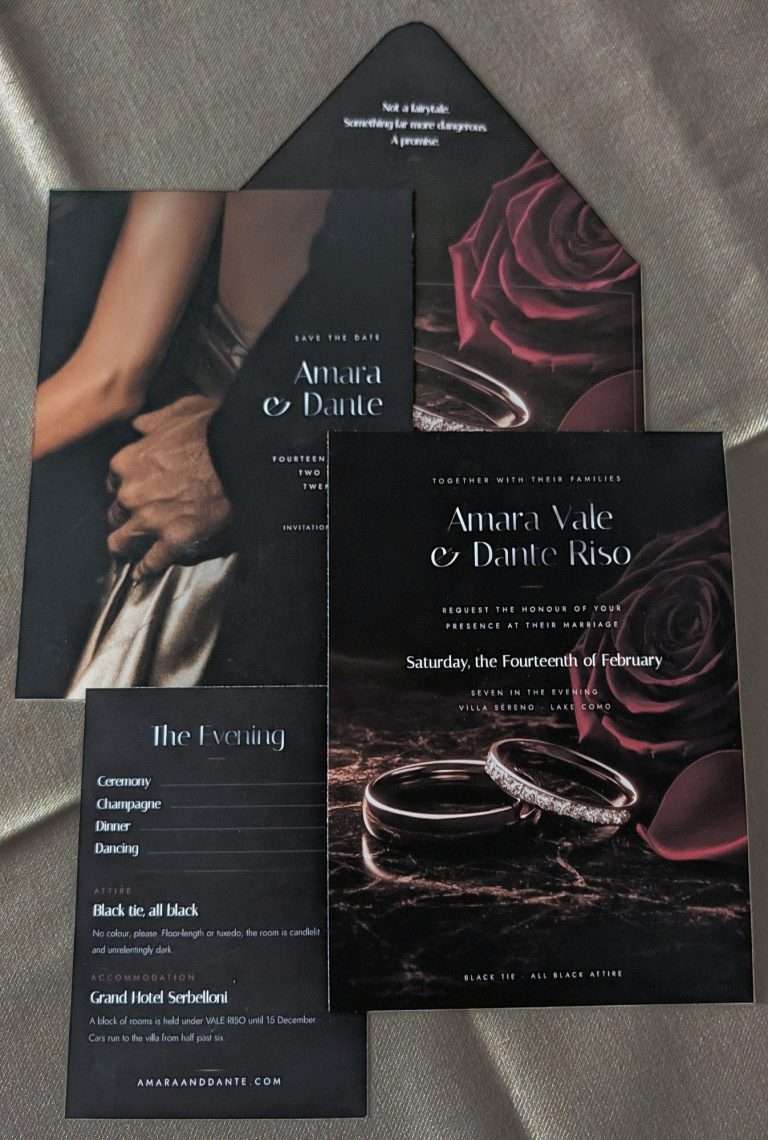
Save-the-dates are also the first time guests see your aesthetic. If your wedding leans editorial (moody florals, candlelight, gilded edges), the save-the-date should hint at that mood. A pastel save-the-date followed five months later by an oxblood-and-candlelight-amber invitation reads as a brand pivot, not a build.
Common mistakes: sending too late (guests already have plans), trying to fit too much information (an essay-length save-the-date overwhelms), or printing on stock so thick the postage doubles. Digital save-the-dates solve all three at once.
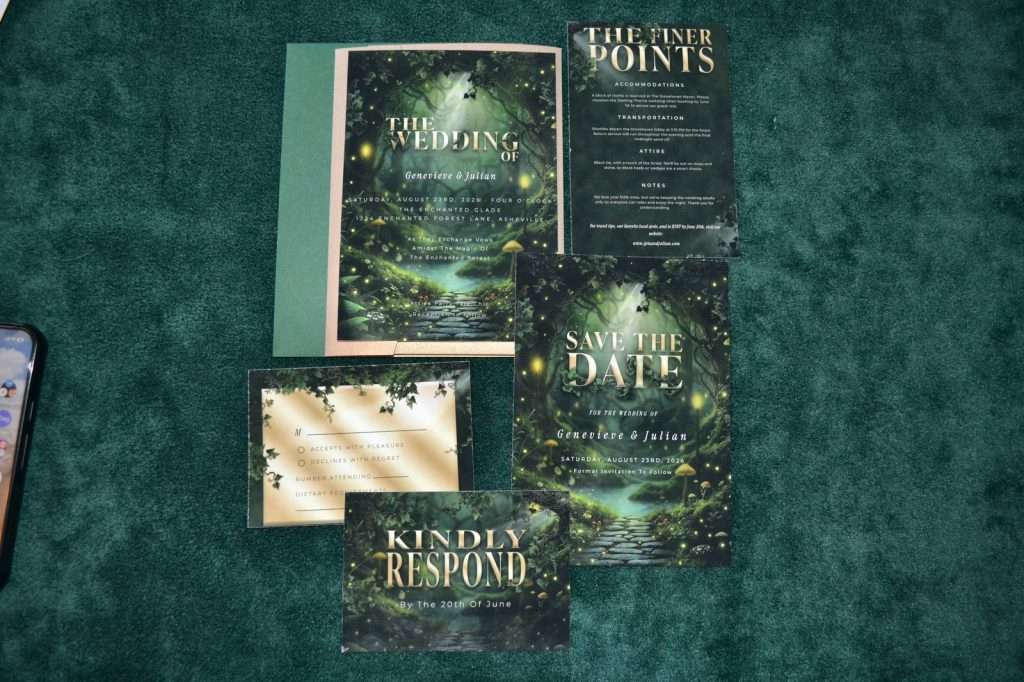
The Invitation Suite, Explained
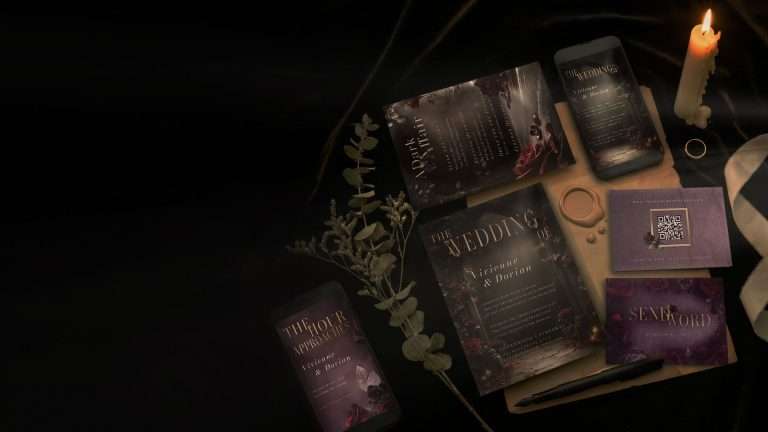
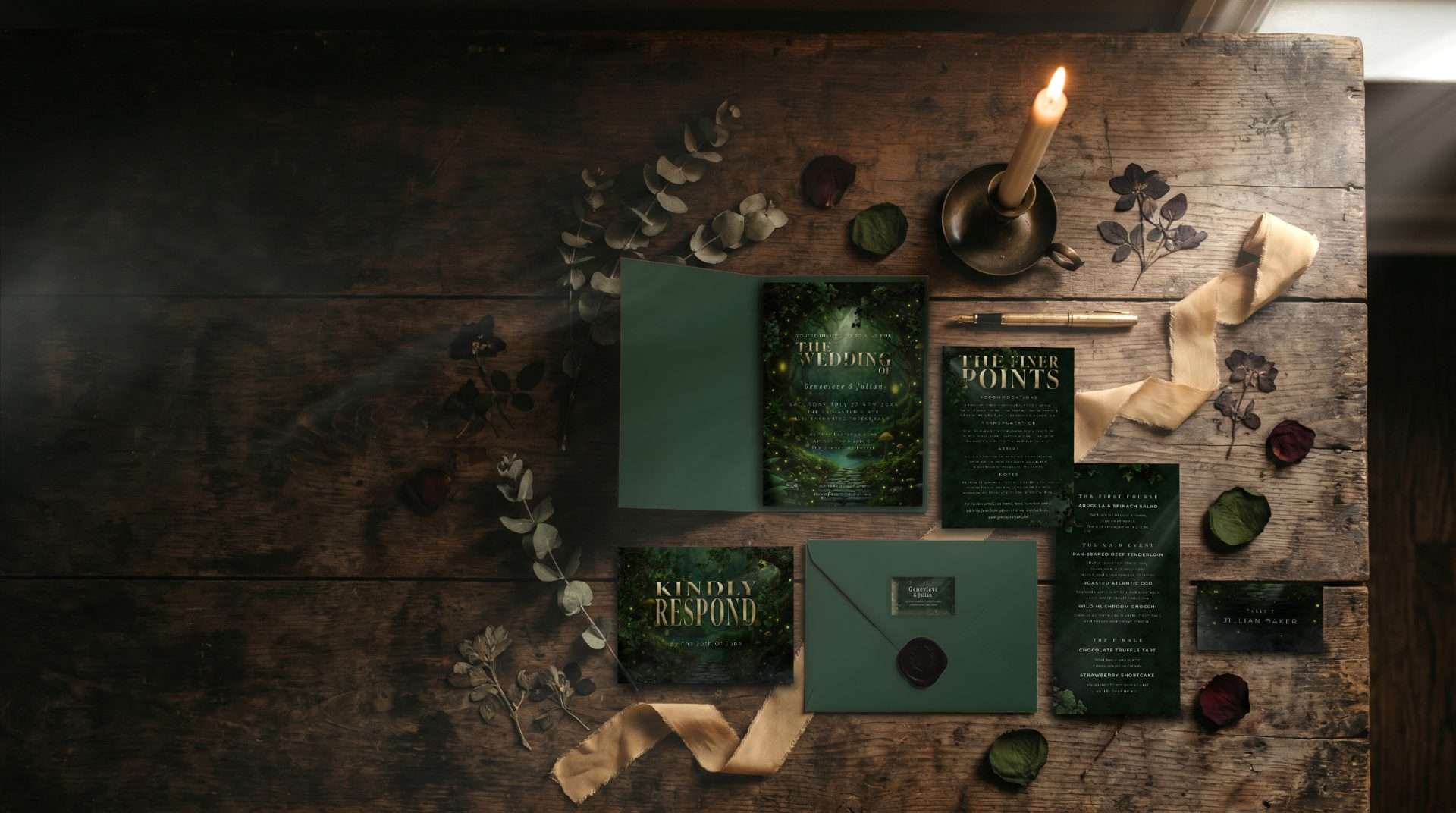
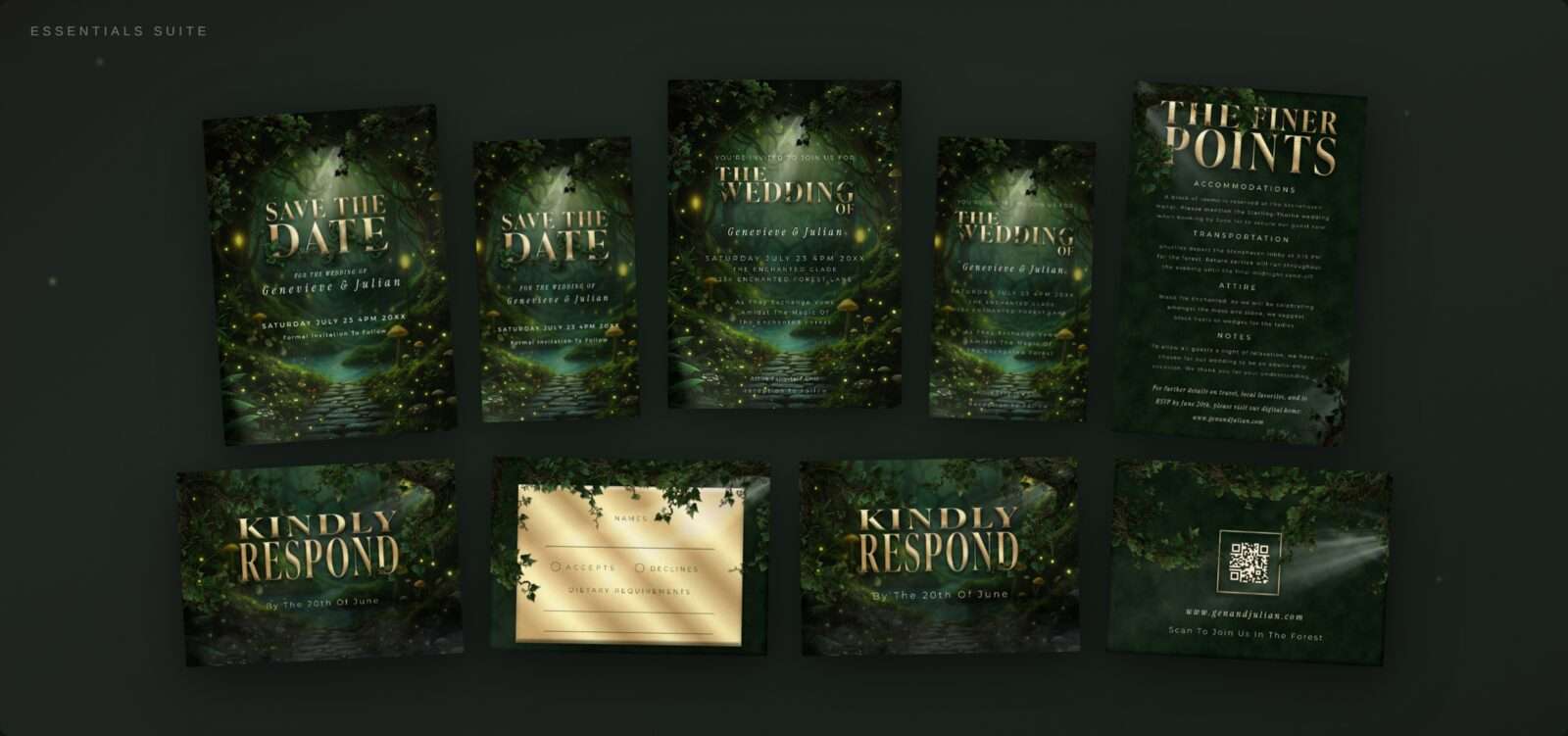
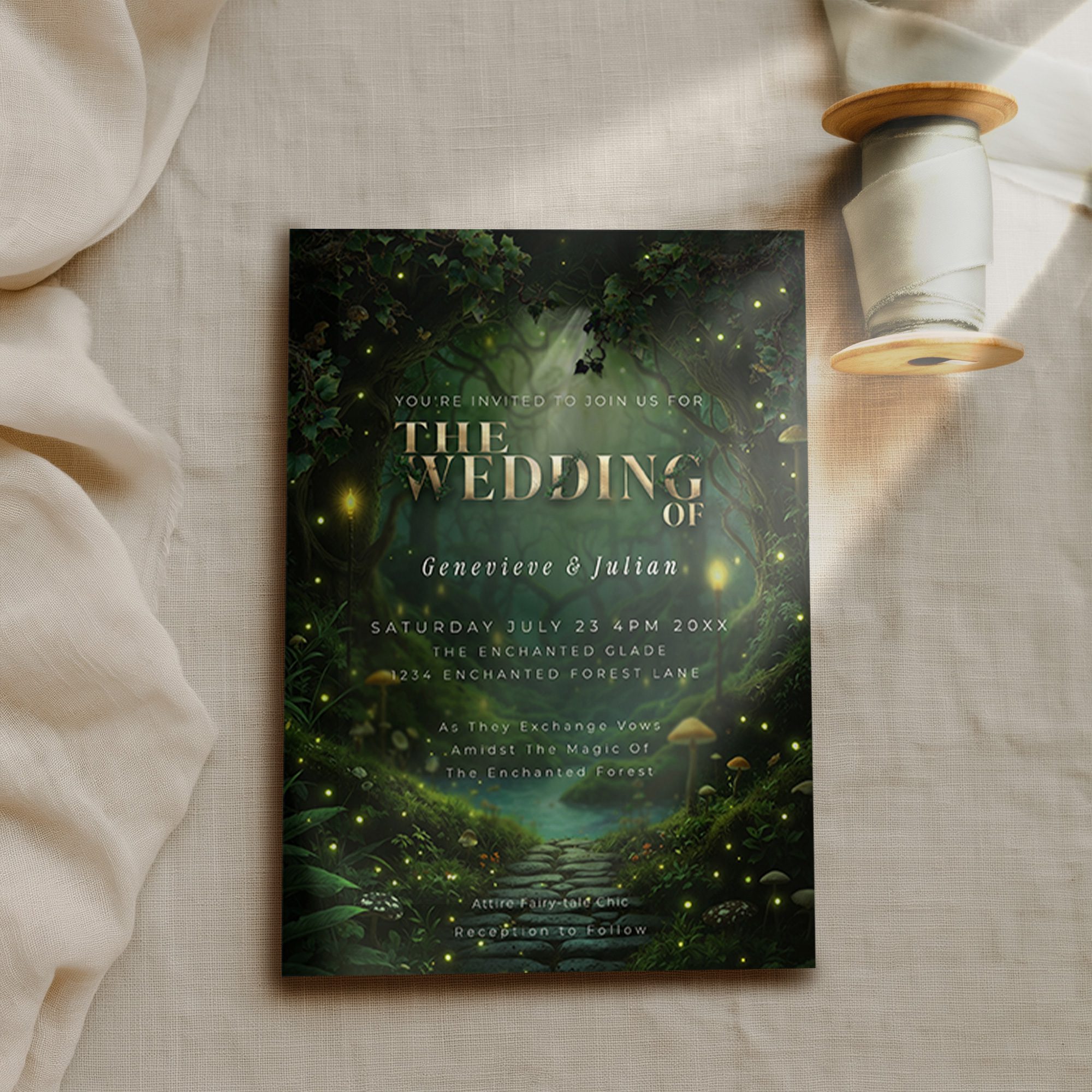
The invitation suite is the centerpiece of your stationery. It’s the single piece that sets the mood, communicates the logistics, and shows guests this celebration is worth dressing up for. A complete wedding invitation suite typically includes four pieces:
Main Invitation
The hero card. It carries the names, date, time, venue, and (often) a single line of dress-code language. This is the piece guests will keep on the fridge, photograph for Instagram, and tuck into a memory box. Spend the most attention here.
RSVP Card
Traditionally a small reply card with a stamped return envelope. Increasingly, couples are pairing a printed RSVP card with a digital RSVP option: a wedding-website URL where guests can also note meal choice, song requests, or dietary restrictions. Digital RSVPs cut weeks off your headcount-tracking timeline and let you skip the cost of return postage.
Details / Accommodations Card
The logistics workhorse. Hotel blocks, transportation, dress code, weekend events, parking instructions, weather notes for outdoor venues. Anything the invitation itself can’t carry without looking cluttered.
Optional Inserts
For destination or multi-day weddings: a weekend itinerary card, a map insert, a rehearsal-dinner card, or a brunch invitation. Keep them visually consistent with the main suite: same paper, same fonts, same palette.
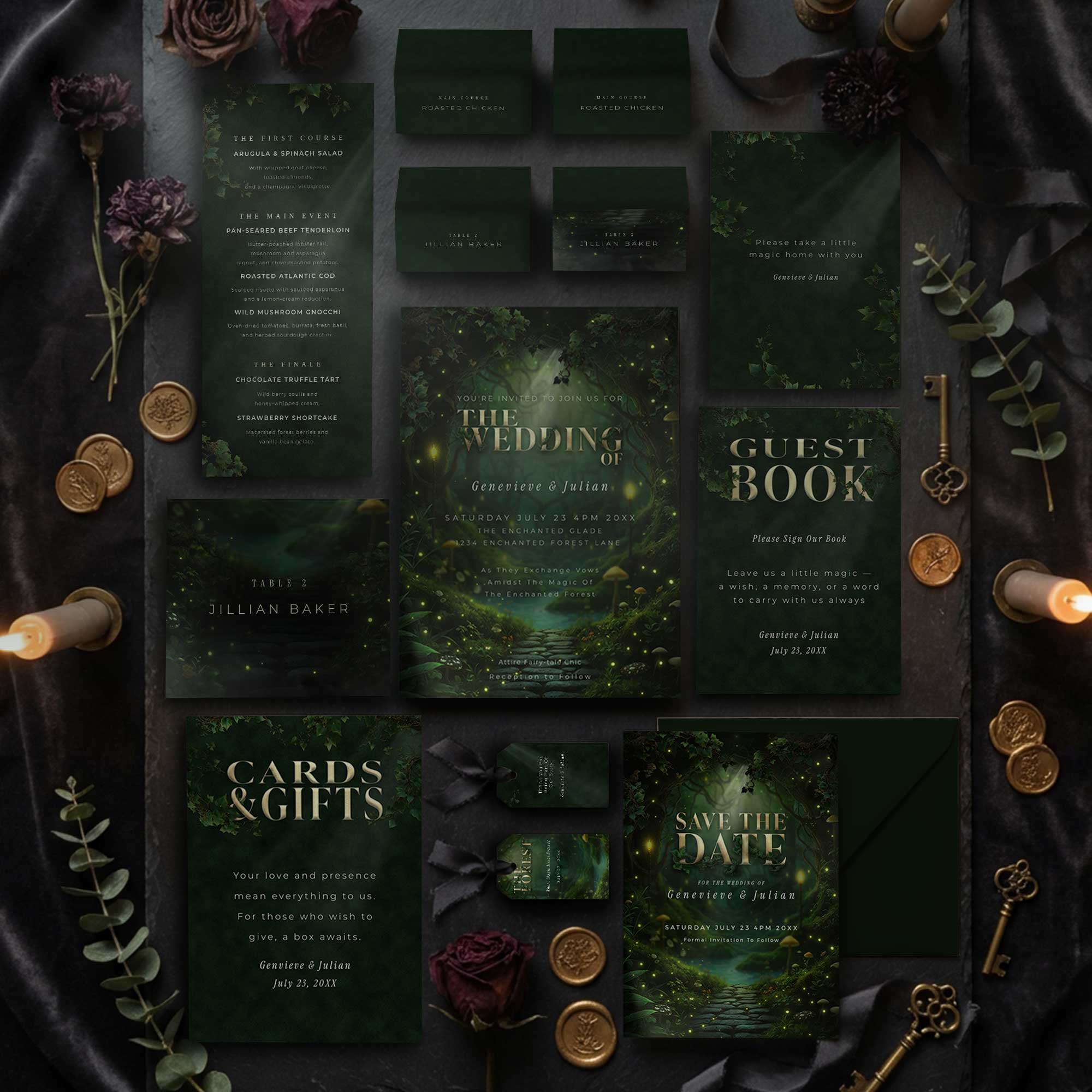
ThornBloom suites include all four pieces (and often more) in one purchase, each set to your details, so you’re never paying à la carte for the details card. Choose a wedding invitation suite once, and every supporting piece is already designed in the same hand.
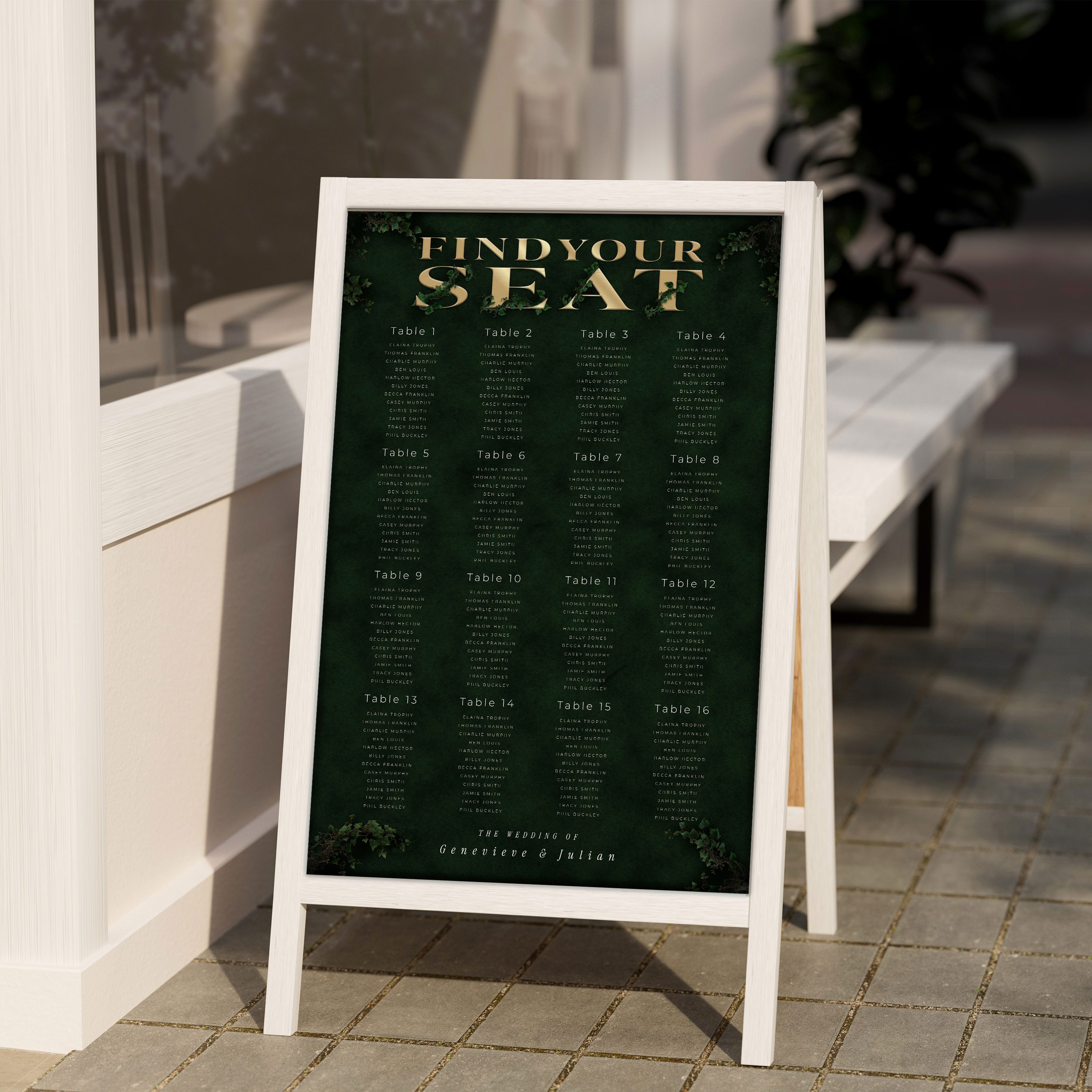
Day-Of Signage and Reception Paper
Day-of paper is the most underestimated part of a wedding stationery checklist. Couples plan the invitation for nine months and the seating chart in nine days. The fix is treating reception paper as part of the same suite from the start.
The standard day-of stack looks like this:
- Welcome sign: typically 18×24 or larger, displayed at the entrance
- Seating chart: 24×36 if you want it readable from a few steps back
- Table numbers: 5×7 cards in elegant frames, one per table
- Menu cards: 4×9 (slim menu) or 5×7 at each place setting
- Bar menu: 8×10 displayed at the bar
- Cards & gifts sign: 5×7
- Guest book sign: 5×7
- Favor sign: 5×7
- Ceremony program: 5×7 folded or 4×9 single-page
The cheat sheet: most small reception signs are 5×7, bar menu is 8×10, and welcome signs and seating charts are large-format (18×24 or 24×36). If you’re working with a Reception Deluxe day-of signage set, the sizing is already mapped to those standards, which means the studio’s printing partners can run the whole stack as a printed and shipped option.
Treat the reception suite as one design family. Identical fonts, identical motifs, identical color palette across all 12 signs. The result reads as a single curated room rather than a Pinterest collage.
Digital vs Printed Wedding Stationery
The biggest decision in modern wedding stationery is whether to go digital or printed, not paper weight or font. Both have a place. Here’s how they actually compare.
Cost Comparison
A printed invitation suite from a custom designer runs $800 to $2,500 for 100 guests, before envelope addressing, postage, or day-of signage. Add the rest of the paper and a fully outfitted printed stationery package easily clears $3,000.
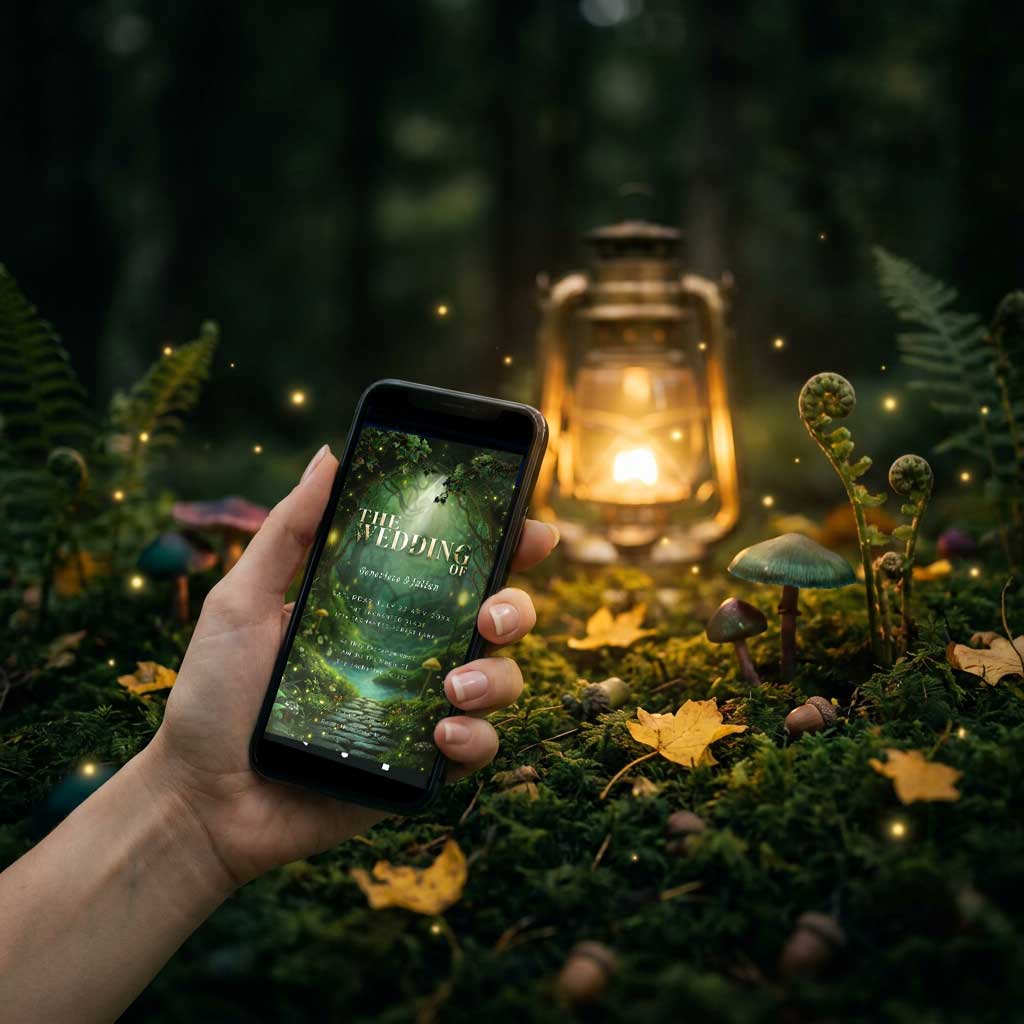
A done-for-you digital suite from ThornBloom starts at $79.99 for the six-piece Essentials Suite (invitation, save the date, RSVP, details card and matching mobile versions) and runs to $249.99 for all twenty-seven pieces of the Grand Wedding Suite. You send your details, the studio sets every piece, and you receive print-ready PDFs. Most pieces can also be printed and shipped through the studio’s printing partners, by quote.
That price difference has nothing to do with digital being less expensive. It’s because you’re paying for design once instead of paying for design plus a printer’s overhead plus a designer’s per-job markup.
Speed and Revisions
Printed suites involve proof rounds. You’ll typically get two or three rounds of revisions, each adding three to five business days. Spelling change at proof three? Add another week. Wrong date at proof four? Reprint, repaid.
ThornBloom works to a proof, not an editor. You send each stage’s details, the studio sets the pieces, and your proof arrives within two business days (three for guest list and seating). Two rounds of refinement are included per product, and if the proof doesn’t match what you sent, that’s our error and we fix it free however many rounds it takes. The cousin who RSVPs late, the venue that updates its address, the bar menu that loses the espresso martini: you tell us and we change it.
Printing Your Suite
Digital delivery is the default: print ready PDFs and mobile ready JPGs, yours to keep, and most pieces can also be printed and shipped through the studio’s printing partners, by quote. Most of the lineup is also available printed and shipped, arranged through the studio’s printing partners. Email info@thornbloomstudio.com with your collection, suite or pieces, rough quantities, wedding date and destination, and we will reply with a quote. We ship to the United States and Canada only.
When Printed Still Makes Sense
Heirloom couples who want letterpress, foil stamping, or hand-deckled edges. Very large weddings (300+ guests) where the time savings of one-and-done printing matter more than the cost. Couples who want to hold a proof in their hands before a single card is printed.
For most couples in 2026, a done-for-you digital suite printed through a quality partner produces invitations indistinguishable from a custom-designed printed suite, for a fraction of what a stationer charges.
How Much Does Wedding Stationery Cost?
Honest cost ranges, no fine print. These assume 100 guests and standard sizing.
| Custom stationer | ThornBloom | |
|---|---|---|
| Design | Commissioned for you, billed per piece | Already drawn; set to your details by the studio |
| Revisions | Charged per proof round, days each | Two rounds per product; studio errors always free |
| Printing | Bundled in, at the stationer’s markup | Printed and shipped by quote |
| What arrives | Printed cards, shipped | Print-ready PDFs at 300 DPI, plus mobile pieces |
| Typical outlay | Four figures for 100 guests | See below: one price for the suite, then your printing |
A ThornBloom suite runs from the six-piece Essentials Suite to all twenty-seven pieces of the Grand Wedding Suite, and printing, if you want it, is quoted separately. What you are not paying for is the design commission, the per-round proof fees, or the printer’s markup on someone else’s margin.
The reason it doesn’t look less expensive is that you receive the same class of file a printed designer works from: 300 DPI, print-ready, full-bleed, with type and layout set by the studio.
The honest read: couples who want elevated, editorial paper goods without a stationer’s commission are the exact audience luxury digital stationery was built for. You’re trading the printer’s markup for a studio that sets the pieces and a proof you approve, not aesthetic for price.
How to Choose a Wedding Stationery Style
Wedding stationery style is the visual identity of your celebration in miniature. Get it right and every paper piece feels inevitable. A few aesthetic lanes to orient yourself:
- Classic: traditional serifs, ivory cardstock, ribbon, watercolor florals. The garden-wedding standard.
- Editorial / luxury: high-contrast typography, asymmetric layouts, deep colors, magazine-grade composition.
- Fantasy: moody florals, candlelit moodboards, gilded edges, a sense of being inside a novel.
- Dark romance: oxblood, plum, candlelight amber, tuberose and dark roses, cinematic. (Our dark wedding aesthetic guide goes deeper here.)
- Art deco: geometry, gold, jewel tones, Gatsby-leaning glamour
- Boho-adjacent garden: pampas grass, terracotta, hand-lettered scripts (we don’t lean here, but it’s a popular lane)
If you’re drawn to moodier, more cinematic weddings (think Gothic libraries, candlelit forests, masquerade galas), the dark fantasy invitation styles cluster post is a good next read. ThornBloom’s collections (Enchanted Forest, Dark Romance, Velvet Opera, Ember Court) sit squarely in this lane and are designed to feel like wearable scenes from your favorite stories.
The choice exercise: pick three adjectives for the wedding (e.g., “candlelit, cinematic, intimate”) and three you want to avoid (“airy, pastel, generic”). The right stationery style usually falls out of that contrast in under five minutes.

How Your Wedding Stationery Is Personalized
“Done-for-you” can sound like it means waiting on someone. It means the opposite: there is nothing for you to build, and nothing to learn.
The process is four steps:
- Choose your suite: pick your collection and the tier that covers what you need.
- Send your details: names, date, venue, wording, guest list. No accounts, no software, no design decisions to make on your own.
- Approve a proof: the studio sets every piece and sends it back within two business days of receiving that stage’s details, three for guest list and seating. Two rounds of refinement are included per product.
- Print: your files arrive as print-ready PDFs at 300 DPI with bleed marks, and most pieces can also be printed and shipped through the studio’s printing partners, by quote.
A suite is delivered in stages rather than all at once, because a couple booking ten months out doesn’t have a guest list yet. Save-the-dates, the invitation suite, day-of details, guest list and seating, and thank-yous each have their own intake and their own proof. Nothing waits on a detail you haven’t decided.
For a full walk-through, read how your wedding stationery is personalized.
Free Wedding Planner + Stationery Checklist
If you’ve made it this far, you’re the couple this guide was built for. You’ve also earned a faster-loading version of the entire checklist.
Grab the free Wedding Paper Planner: every checklist in this guide as a printable PDF, plus a fillable stationery timeline you can drop your dates into and pin to the fridge.
It’s the single resource we’d hand a friend who just got engaged.
Frequently Asked Questions
What is included in wedding stationery?
Wedding stationery includes three categories of paper goods: pre-wedding pieces (save-the-dates, invitations, RSVP cards, details cards, envelope addressing), day-of pieces (welcome signs, programs, menus, place cards, table numbers, seating charts, bar menus), and post-wedding pieces (thank-you cards, photo announcements). A fully outfitted wedding typically uses 15 to 25 distinct paper pieces designed to a single visual identity.
When should I send save-the-dates and invitations?
Send save-the-dates 8 to 10 months before the wedding (12 months for destination weddings or holiday-weekend dates). Mail invitations 6 to 8 weeks before the wedding for domestic guests, and 10 to 12 weeks before for destination weddings. Set the RSVP deadline 4 to 6 weeks before the wedding so you have a confirmed headcount in time for the caterer’s deadline.
How much does wedding stationery cost?
Custom printed wedding stationery runs into four figures for 100 guests once you count save-the-dates, the invitation suite, day-of signage and thank-you cards. A done-for-you ThornBloom suite starts at six coordinated pieces and reaches all twenty-seven, and printing, if you want it, is arranged through the studio’s printing partners by quote. You pay for the design once and for printing at cost, without a stationer’s markup on either.
What is a wedding invitation suite?
A wedding invitation suite is the coordinated set of pre-wedding paper that arrives in one envelope: the main invitation, the RSVP card (printed or digital), the details/accommodations card, and any optional inserts like a weekend itinerary or map. ThornBloom suites include all of these, set to your details in the same visual language so the full mailer reads as one polished package.
Is digital wedding stationery cheaper than printed?
Yes, by a significant margin. A custom printed invitation suite for 100 guests runs well into four figures; a done-for-you digital suite from ThornBloom costs a fraction of that, and printing is quoted separately. The saving comes from paying for design once, rather than for design plus a printer’s per-job markup. Arranged through the studio’s printing partners, the result is indistinguishable from a suite you had custom printed yourself.
Do I need any design experience?
None at all. No editing either. You send your names, date, venue and wording, and the studio sets every piece for you. A proof comes back within two business days of each stage’s details reaching us, and two rounds of refinement are included per product. There is no editor to open, no software to install and no layout decisions to make.
What size should my day-of wedding signs be?
Standard day-of sign sizing: welcome signs 18×24, seating charts 24×36, bar menus 8×10, and most smaller signs (cards & gifts, guest book, favor, table numbers, menus) 5×7. Ceremony programs are typically 5×7 folded or 4×9 single-page. Reception Deluxe sets from ThornBloom are pre-mapped to these standards so the studio’s printing partners can produce the entire stack.
Do I need to send thank-you cards after the wedding?
Yes. Etiquette holds that thank-you cards should be sent within three months of the wedding (some traditions stretch to a year, but three months is the modern standard). Each card should be handwritten and reference the specific gift. Digital thank-you cards are increasingly accepted for guests who attended virtually or sent digital gifts; for in-person guests and traditional gift-givers, a printed card still carries the most weight.
Ready to Design Your Suite?
You’ve got the map. The next step is choosing the visual world your stationery lives in.
Our Enchanted Forest invitation suite is fully live: moody woodland florals, candlelight, deep moss greens, and warm gold detailing. It’s the collection couples reach for when they want a wedding that feels like the inside of a fairy tale rather than the outside of a Pinterest board.
Dark Romance (oxblood, plum, candlelight amber) is live alongside it. Two more collections are on the way: Velvet Opera (gilded masks, midnight velvet) and Ember Court (sovereign gold, dragon-fantasy heraldry). Join either waitlist and you’ll be the first to know when those suites open.
All ThornBloom suites are set for you by the studio: no design experience required, no editing at all, every piece in the same hand, the whole wedding feeling like one story instead of twelve separate purchases.
And if you haven’t yet, grab our free Wedding Planner Bundle. It’s the checklist version of this entire guide, ready to print and pin.