An all black, black tie wedding sits on a narrow edge. Done well, it reads like the most restrained, most expensive room your guests have ever stood in. Done carelessly, it reads like a themed party that got away from itself. The difference rarely comes down to a bigger budget or a more dramatic venue, but to a handful of specific decisions made early and held to for the rest of planning. This guide covers the ones that matter most: wording the attire line so guests understand it, why one cut of colour beats a whole palette, and how lighting and metal finishes decide whether the room reads cold and expensive or simply dark.
In This Article
Why All Black Reads Elegant or Reads Like a Costume, and What Makes the Difference
Black is not a theme. A theme is a set of props and signifiers, the kind of thing that announces “gothic” or “dark academia” out loud through signage or costuming until the room starts explaining its own concept. An all black wedding, styled correctly, has none of that. It is a colour discipline, not a costume, and the moment a room needs to explain itself, it has crossed from restraint into theme.
The rooms that succeed say nothing about themselves. The black is simply the palette, the way ivory or sage would be at another wedding, and every other decision, stationery, linens, attire, follows the same discipline: quality over decoration, and a refusal to pile on extra elements just because the base colour leaves room for drama. An editorial room trusts fabric, light, and one deliberate accent to do the work. A costume room tries to do it with quantity, and quantity is exactly what tips the whole thing over.
Wording the Attire Line
Most of the anxiety around an all black wedding starts before the wedding day, on the details card, where guests try to work out what “black tie, all black” actually means for them. Get this wording right and half the styling problem solves itself, because guests who understand the assignment dress in a way that supports the room instead of clashing with it.
What “Black Tie, All Black” Actually Tells Your Guests
Black tie is a specific dress code: tuxedos or dark formal suits for men, floor length or formal attire for women. Adding “all black” narrows that further, and guests need the narrowing spelled out rather than implied. A line like “Black tie, all black. Floor length or tuxedo” tells a guest exactly what to wear. Vague wording is the most common reason a handful of guests show up in navy or deep burgundy, a small inconsistency a restrained room does not want.
Be equally specific about accessories if it matters to you. Specificity reads as consideration, not control.
Saying “No Colour, Please” Without Sounding Like a Rule
“No colour, please” can sound blunt on its own, and some couples soften it into something so vague it stops working. The better approach keeps the line direct but gives it a reason, so it reads as a request about the room rather than an order about the guest: “No colour, please. The room is candlelit and unrelentingly dark, and we would love for the black to carry through.” That single sentence states the rule plainly, explains why it exists, and gives the guest something to feel part of rather than something to comply with.
Do not apologise for the request in the wording itself. Guests generally want a dress code stated with confidence rather than hedged, and the couples with the most consistent turnout in black are the ones who asked for it plainly, once.
The One Accent Rule
An all black room without a single point of contrast can feel flat by the second hour, especially under photography, where a fully monochrome frame loses depth. The fix is not a colour palette. It is one accent, used with total consistency.
Choosing a Single Cut of Colour Instead of a Palette
Pick one colour and let it do all the work. A deep wine, a single jewel tone, or one saturated hue against all that black reads as intentional in a way three or four accent colours never will. The instinct to add “just a little more” variety is almost always a mistake here. Every additional colour dilutes the first, and a single confident cut becomes a scattered palette that undercuts the point of going all black.
Test this before you commit: if you can point to your accent colour in one object, a ribbon, a seal, a runner, and say “that is the one”, you have it right. If you find yourself listing three or four places it shows up in slightly different shades, pull it back to one.
Where That One Accent Should Live (and Where It Should Not)
The accent works best concentrated in a small number of high-visibility places rather than spread thin across the room. A single runner down the centre of each table, a wax seal on the place cards, a sash on the head table chairs, or a lit accent behind the bar are strong choices, each a single, contained object rather than a smear of colour across many surfaces.
Avoid letting the accent leak into lighting gels, linens, or more than one category of object. The moment it shows up in the tablecloths and the chair covers and the signage, it stops reading as “one cut” and starts reading as a second base colour. Keep it rare, and it reads as expensive. Spread it out, and it reads as decoration.
Lighting Makes or Breaks an All Black Room
No other decision affects an all black wedding as much as lighting. The same room can read as intimate and expensive under one setup, and flat, murky, and underlit under another.
Candlelight Over Overhead Light
Overhead lighting flattens black. It removes shadow, and shadow is what gives a dark room its depth. Candlelight does the opposite: it creates pools of warm light against the black, and every surface, glass, cutlery, a single accent object, catches that light instead of disappearing into it. Talk to your venue and planner early about layering in low, warm light, candles, low pendant fixtures, minimal uplighting, rather than relying on standard overhead fixtures. A room lit from above feels like a dark version of a normal room. A room lit from candle height feels like its own atmosphere.
Metal Finishes That Read Cold and Expensive
Metal finishes carry as much weight as fabric here, since they are often the only reflective surfaces guests see up close. Warm gold reads as festive and traditional, a fine choice for plenty of weddings, but it works against this register. Cooler, matte finishes, gunmetal, brushed pewter, blackened iron, hold the room’s tone instead of fighting it. Choose one and carry it through flatware, frames, and any hardware guests will notice, for the same reason you choose one accent colour: consistency reads as intention.
Building the Look From the Stationery Out
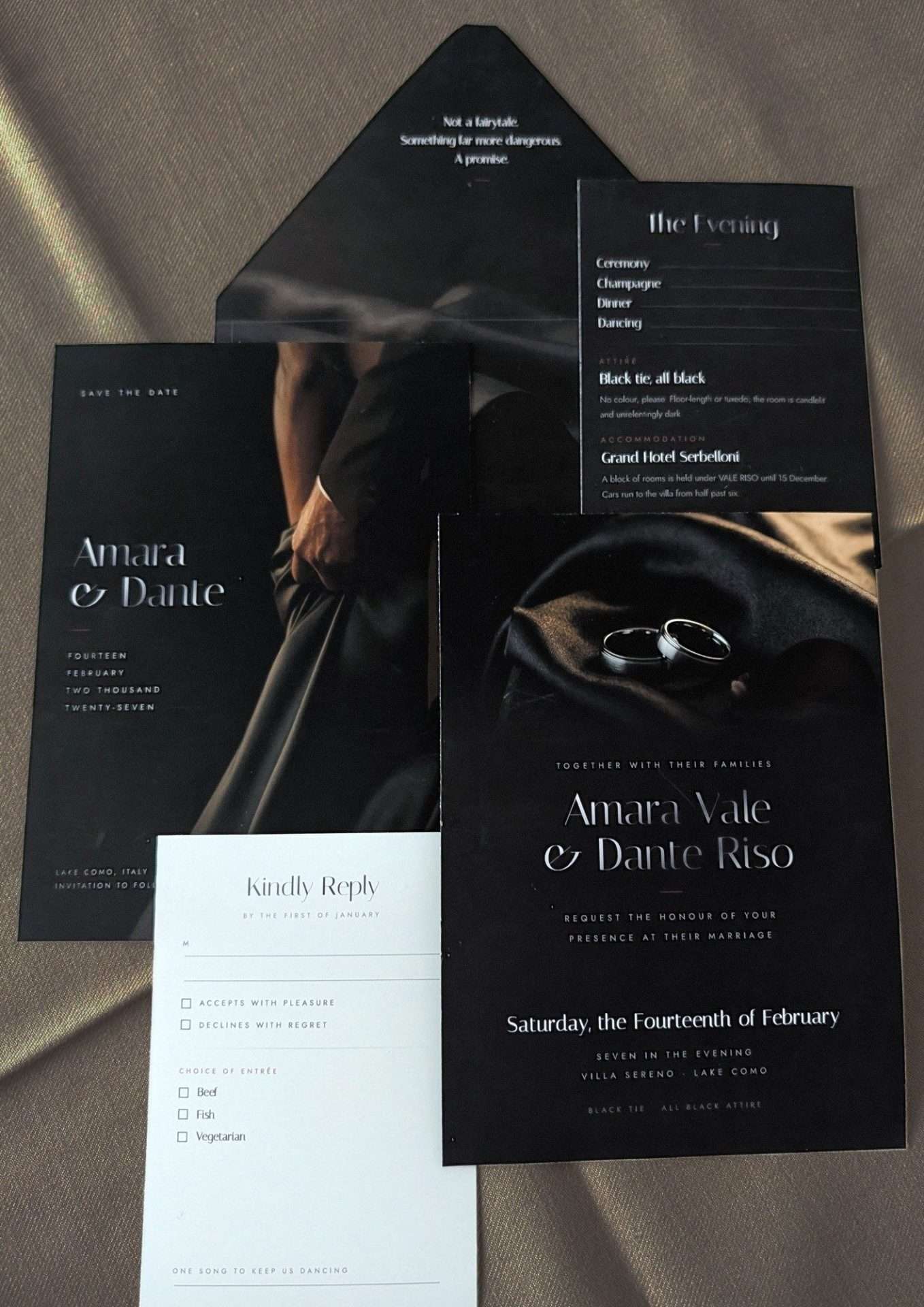
Every guest’s first impression of an all black wedding arrives before the wedding day, on paper. The save the date and invitation set the tone for everything that follows, so the restraint you want in the room needs to already be visible in the stationery. A save the date in warm gold and soft serif type tells guests to expect one kind of evening. A save the date in smoke black and gunmetal, with a single cut of colour and nothing else competing for attention, tells them to expect the room you are planning to build.
This is also where the one accent rule and the attire wording meet in a single object. A well designed suite for this kind of wedding should already show restraint: one photographic image rather than illustrated ornament, one accent colour used once, and an attire line that states the dress code plainly. Get the stationery right, and everything else only has to match what the paper already promised.
Frequently Asked Questions
Will an all black wedding look too dark in photos?
Not if the lighting is planned for it. The risk is not the colour black itself, it is flat overhead lighting with no warm light sources close to eye level. Candlelight, low pendant fixtures, and a single well placed accent colour all give a photographer something to work with, and a well lit all black room photographs with more depth and contrast than most lighter colour palettes.
What does “black tie, all black” mean on an invitation?
It combines a standard formal dress code, black tie, tuxedos and dark formal suits for men, floor length or formal attire for women, with an added colour restriction: no colour anywhere in the outfit unless you state otherwise. Guests respond best when the line is stated this specifically rather than left as a general mood description.
Can I add more than one accent colour to an all black wedding?
You can, but it changes what the room reads as. One accent, used consistently, reads as restrained and intentional. Two or more accents start to read as a colour palette rather than a black room with a single cut of contrast, a different, equally valid style, just not the “editorial, cold, expensive” look this guide describes.
What venues suit an all black, black tie wedding best?
Venues with good architectural bones and controllable lighting tend to work best, since so much of the effect depends on layering in warm, low light rather than relying on existing fixtures. Ballrooms, industrial spaces with high ceilings, and venues that permit candles or a designed lighting plan give you more room to build the atmosphere than a space with fixed, bright overhead lighting you cannot adjust.
Where can I find stationery that already matches this aesthetic?
Look for a suite built around this register rather than a general dark theme, since illustrated dark stationery and editorial, photographic black tie stationery read very differently despite both being “dark.” A suite built with smoke black grounds, restrained photography, and a single cut of colour already carries the discipline this guide describes.
See the Look Already Built Into a Suite
Everything in this guide, the restraint, the single accent, the cold, deliberate use of metal and light, is the same design language behind the Obsidian Vow collection. It is a done-for-you stationery suite built for exactly this kind of black tie, all black wedding: smoke black grounds, one cut of deep wine, and photography instead of ornament. You send the studio your details, the studio sets them into the suite as designed, and Caelin proofs every piece before it is finalized.
If you want to see the full range of pieces before you decide, the Obsidian Vow Essentials Suite is a good place to start. For more planning guides like this one, visit the ThornBloom blog.